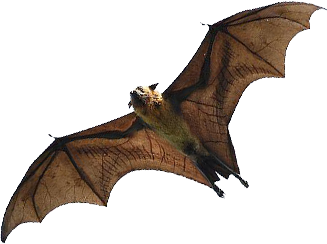
Top 10 Myths And Facts About Bats!
Fact or Fiction?
True or False?
MYTH #1 – Bats are dirty animals
FACT – Flying-foxes are exceptionally clean animals. They constantly groom themselves and their young.
They even ‘invert’ or hang right side up in order to avoid soiling themselves! Although during hot weather a mother bat may urinate deliberately on her young pup to help cool it down.
MYTH #2 – Bats suck your blood
FACT – Blood-sucking or Vampire Bats are only found in Central and South America. These small bats weigh less than 50 gms. And their main prey is domestic livestock, particularly cattle, goats and fowl.
MYTH #3 – All bats live in caves
FACT – While a large proportion of Australian microbats do live in caves, many microbats choose to live in tree hollows, roofs of houses, telephone junction boxes, sheds, and rolled up beach or garden umbrellas.
In fact microbats may live anywhere that provides stable conditions, protection from weather, predators and safety.
MYTH #4 – Bats are pests and serve no purpose
FACT – Flying-foxes and Blossom bats play a vital role in the pollination of flowers and seed dispersal of our native forests.
A single Flying-fox can disperse up to 60,000 seeds in one night. Without bats our forests become genetically weak. The diversity of our species of flora diminishes. And most forests would not survive future generations.
As for microbats, they are capable of eating their own body weight in insects each and every night! So they are excellent natural controllers of moths and mosquitoes. Without microbats our insect populations would explode!
MYTH #5 – ‘Blind as a bat’
FACT – Bats are not blind, not even the microbats, although they do not rely heavily on sight as much as Flying-foxes do. Flying-foxes have excellent eyesight (20 times better than our own!).
In fact they can see up to 1 kilometre at night. Many of our native trees have evolved to have light coloured blossoms and fruit. This makes them highly visible to Flying-foxes on dark nights.
MYTH #6 – Bat droppings can give you Lyssavirus
FACT – People are NOT exposed to Lyssavirus (otherwise known as Australian Bat Lyssavirus or ABLV) when Flying-foxes fly overhead. Or when they roost or feed in garden trees. Or even from touching their droppings.
Lyssavirus can ONLY be transmitted through deep tissue bites or scratches.
MYTH #7 – Bats get tangled in your hair
FACT – Flying-foxes are all good navigators with excellent eyesight. Plus they are very shy animals with a natural fear of humans.
And microbats use echolocation to specifically avoid objects (as well as locate their insect prey). Therefore even an accidental collision with a bat is most unlikely.
MYTH #8 – Bats are cold and clammy to touch
FACT – Bats are warm, fuzzy and in fact quite cute! Their fur is very soft and their wing membrane feels similar to the skin of our own eyelids.
MYTH #9 – Bats are the only mammals in the world without an anus (!)
FACT – Bats are placental mammals with exactly the same excretory organs as ourselves. They have a rapid digestion (approx. 20 minutes) and an inability to digest fibre.
So bats chew the fruit they eat, extract the juice and spit out the remains. The silly myth about bats excreting from their mouths is simply a misinterpretation of this behaviour.
MYTH #10 – Bat droppings strip paint from cars and houses
FACT – Bird droppings are actually more corrosive than flying-fox faeces. Soaking the stain with a damp rag is the easiest way to remove it.
Unless the paint is old or peeling and the faeces is washed off promptly, no permanent damage should result from a bat leaving it’s calling card.
For more interesting facts (and NOT fiction!), check out these great brochures from the Australian Bat Society:
Bats Are Fascinating Creatures (ABS) and Australian Flying-foxes